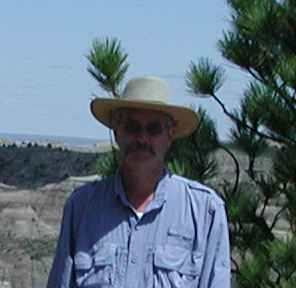
Near the petrified forest close to Buffalo, Wyoming, another mysterious early artifact related to human history can be found for anyone to see. Nearby, a beautiful landscape of red earth and dusky green vegetation can be visited with no crowd or people present on most days.
src="http://pagead2.googlesyndication.com/pagead/show_ads.js">
A mystery from Buffalo, Wyoming.
In the Jim Gatchell Museum in Buffalo Wyoming lies another mysterious artifact, one of many to be found in the small museums of America. Photographs were not allowed in this museum so I respected that and there is no photo of this artifact to be found here.
The museum, as most museums go, has a lot more of the recent historical artifacts and information content-wise. That makes sense though as the recorded history of the western settlement of America was well documented. One of the more fascinating stories I learned here was the story of the Johnson County War that took place in this locale. As far as our modern movies represent history, a very good movie of this incident in history is represented by the movie of the name Johnson County War.
The Jim Gatchell museum houses much of the story and many artifacts that have been saved and preserved from the Johnson County War. It is a very interesting story from the western settlement era. After taking in the first floor of the museum one descends the staircase to the basement. Along that path in a shadow box the leather whip made by Tom Horn is displayed.
In the basement of the museum in a glass case amongst many other objects I spotted an object with a label that said something to the effect of "From Ripley's Believe It Or Not". As I remember it, the description detailed the object as being found some 100 or so miles west of the museum.
It was described and appeared to be the the tip of a bow (as in a bow and arrow) but it was petrified...petrified.
To my eyes it certainly looked just as it was described. It had the notch and was tapered and curved exactly as a tip of a bow would be imagined to be. I would estimate it from memory to have been 3 to 4 inches in length.
There are theories about the Biblical flood and differing aspects of petrified wood. I won't delve into those ideas here. Were this artifact to be as represented and is not an astronomical odds shaped petrified broken branch, one has to wonder either about history in terms of the ages of man, or the accounts and accuracy of...well...what the process of petrified wood is.
If the former is to be considered, one needs to then consider the odds of the same type of weapon, a bow and arrow, and what the odds are that it was apparently re-invented in the same fashion some millions of years later are.
To the southeast of Buffalo there is to be found a smaller attraction by the name of The Petrified Forest. Not exactly the same as the Arizona attraction, yet the same in terms of what it actually is. It is almost a perfect western landscape where one can almost imagine the dinosaurs wandering about.
The red earth tips, earth, and the western vegetation mostly hide the smaller evidence of an ages old forest. It is however, a beautiful area to visit and not smothered by any commercialism, advertisements or people.
In a smaller note of mention, the area of Gillette, Wyoming to the southeast is an area rich in oil and at least once to my knowledge was a boomtown of the same. In the west it seems that oil, oil shale and ancient life go together geographically.
Just another mystery this petrified bow.
Saturday, December 8, 2007
A Petrified Bow Tip In Wyoming


Thursday, November 29, 2007
Runestone in Minnesota
While traveling into Minnesota from North Dakota there was a stop at Ashby for a week. Taking in the local sites, birdwatching and museum visiting, I came across this interesting artifact known as the Victor Setterlund Runestone at the Grant County Museum in Elbow Lake, MN.
The rest of the museum was in fact more interesting but this caught my eye as I always look for strange or unexplained artifacts, a physical piece of material more substantial than most legends.
Enclosed in a glass case with a note of explanation on the side of the case explained the following object of interest. It is really a beautiful piece of work to look at and one could in some way hope to chat with Mr. Setterlund to fill in some blanks of the story.
Although there are several unexplained runestones that exist and can be visited, and more mentioned to exist while their location is kept somewhat of a secret allegedly to preserve them, this one came with an open explanation.
On a note on the side of the glass case this runestone is enclosed in reads:
The Victor Setterlund RunestoneI appreciate the honesty of the museum and this little chunk of history. Later on in my travels I will visit a much larger runestone that is certainly much more historical and seemingly unexplained.
caused considerable excitement when found in 1949. The runic inscription reads "1776 Four Maidens Set Camp On This Hill". A cast of this stone was sent to Dr. Holand, the Kensington Runestone Authority, who misinterpreted the date as being 1376, the same period as the Kensington Runestone which added to the confusion. Mr. Setterlund, who had little formal education, studied runic characters and by this self study was able to correctly inscribe this prank inscription. It is displayed, not only because of the exitement (sic) it caused at the time, but as evidence that such a runestone could be made by a Grant County farmer.
Tuesday, November 27, 2007
Strange Rock Art
In central New Mexico in the town of Truth Or Consequences there is a very nice museum by the name of The Geronimo Springs Museum. This museum houses memorabilia of the times of the American West and the Apache Nation. Also on display are even earlier instances of inhabitants of the region, the Mimbres. The Mimbres people created beautiful pottery, more to been seen later.
In one of the cases containing rock art examples I couldn't help but be surprised to see what looks like a delta wing fighter on one section of a rock.
The label indicates that it was found in Sierra County and donated to the museum. It appears to have insignias on the wings and barrels protruding from the front of the plane.
Across the country in small to large museums there are fascinating objects to be seen and stories to read and hear. In many instances one cannot be sure if objects are very much real or potentially fabricated at some time in the past. They are, nevertheless, very interesting and available for all to see.